For Realtors
Are you a realtor? Let's work together.
We solve. We guarantee.
Rockwater is broker-friendly. We make it easy to bring your clients a quality home, with the transparency you need to look good in front of them.
Have a question about a client's lot or one of our homes? Ask our AI Advisor — it knows our models, specs, and the zoning, utility, and permitting rules county by county.
Why partner with usClear specsA real productMulti-state coverageWe handle the hard parts
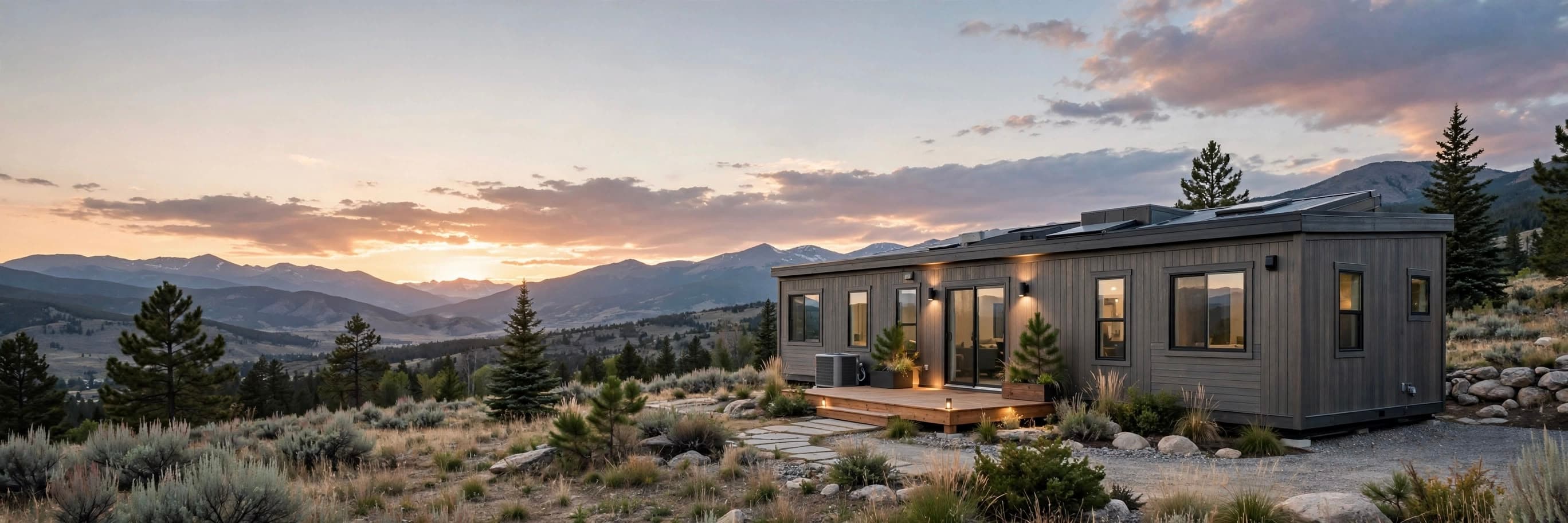
Bring your client and their land. We'll match a home, walk through specs and timeline, and keep you in the loop the whole way.
Broker inquiry
Tell us about you and your client. We'll reach out to coordinate — no commission specifics needed, just a real conversation.
Can your client place a manufactured or modular home on this property?
Run this checklist before the land purchase. Every jurisdiction is different — verify before buying.
Zoning & land use
- Verify the planning and zoning requirements for the property's jurisdiction — each county, city, and metro district sets its own rules.
- Confirm the property's zoning designation and that manufactured or modular homes are a permitted use.
- Check whether a special-use permit or variance is required, and review overlay districts or subdivision-specific regulations.
Setbacks
- Confirm front, rear, and side setbacks — and corner-lot setbacks if applicable.
Home requirements
- Some jurisdictions regulate minimum square footage, roof pitch, foundation type, exterior materials, garage requirements, architectural standards, and skirting (for manufactured homes).
Utilities
- Confirm access to electrical service, water, sewer or septic, natural gas or propane, and internet service.
Site access
- Verify adequate access for home delivery, crane placement (for modular), utility installation, and emergency vehicles.
HOA, covenants & design standards
- Even when zoning permits manufactured housing, subdivision covenants, metro district rules, or HOAs may add restrictions on style, finishes, garages, landscaping, or fencing.
Did you know?
Manufactured and modular homes offer genuine construction quality, energy efficiency, and long-term value. Smart land planning unlocks affordable housing and strong investment potential — and because every piece of land is unique, local research is the real key to a successful purchase.
Before your client buys land
- The property allows manufactured or modular homes.
- All zoning, setback, and permitting requirements are understood.
- Utilities and site access can support delivery and installation.
- Any HOA, covenants, or design restrictions are reviewed.
- Financing options are available for the home and land type.
- The home can be titled as real property (purged) if traditional financing is desired.
Pro tips for realtors
Critical industry realities to keep in mind when you're evaluating a lot or advising a client. These are the details that catch people off guard.
Site evaluation nuances
HUD tag vs. IBC code. A manufactured home carries a red HUD tag and is built to the federal HUD Code, uniform nationwide. A modular home carries an IBC-code label and is built to state and local code — the same code as site-built. Jurisdictions treat the two very differently for zoning, so know which one your client is actually buying.
The perc test. If the lot needs a septic system, add a soil/percolation-test contingency to the land contract. If the soil won't perc, an engineered septic system can cost tens of thousands more — and sometimes the lot isn't buildable at all.
Transport logistics route survey. Delivery trucks carrying home sections have to clear low-hanging power lines, tight turns, and weight-restricted bridges for miles before they reach the property. A quick route survey with the transporter catches blockers early — while your client can still walk away.
Utility connection (tap) fees. “Utilities available at the street” doesn't mean cheap. Water tap fees and electrical drop fees can run thousands of dollars before a single wire or pipe is run. Get real cost quotes from the utility, not just “available.”
Financing & titling
The purge. In Colorado, a manufactured home starts as personal property with a vehicle title. To finance it like real estate (FHA, VA, Conventional), it must be “purged”: the vehicle title is surrendered to the DMV and a Certificate of Permanent Location is recorded. Until then, it's legally a car, not a house.
The 1976 HUD boundary line. If an existing manufactured home was built before June 15, 1976, it's a pre-HUD “mobile home,” not a manufactured home. Most traditional lenders won't finance pre-1976 units, which sharply limits your buyer pool. Always check the build date.
The double-wide rule. Many conventional and government lenders require a manufactured home to be at least a double-wide (multi-section) for a 30-year mortgage. Single-wides are much harder to finance through traditional real-estate loans, even when permanently attached to the land.
Colorado legal & regulatory updates
2026 “Red Tape” law (SB25-002). Colorado's 2026 SB25-002 sets a statewide standard that preempts local building codes for factory-built homes, replacing the county-by-county patchwork. Design and safety approvals now run through the Colorado Division of Housing, streamlining permitting in many jurisdictions.
WUI (wildland-urban interface) fire codes. Colorado keeps tightening wildland-urban interface fire rules. For foothills or mountain lots, the factory build must meet Class A fire-rated assemblies — ignition-resistant venting, siding, and roofing. Confirm the home is specified to WUI before ordering.
Extreme climate engineering. Don't let a client buy a standard out-of-state model for a mountain lot without checking the structural specs. Summit County, for example, requires roofs engineered for 100 psf snow load plus high wind exposure. If the factory didn't build to those exact ratings, local inspectors will deny the Certificate of Occupancy.
The real edge
The deals that close smoothly are the ones where the hard questions get asked early — zoning, utilities, titling, the perc test. Raising them up front doesn’t kill the sale; it makes you the realtor your client refers to everyone they know.
Planning & zoning resources
Start with the planning or zoning department where the property sits. When in doubt, call them for clarification. In the Pueblo region, these are the departments you'll work with:
- Pueblo County (unincorporated) — Planning & Zoning
- City of Pueblo — Planning & Zoning
- Pueblo West Metropolitan District
- Colorado City — Planning & Zoning
- Custer County — Planning Department
- El Paso County — Planning & Community Development
- Fremont County — Planning Department
Ready to bring your client a home?
Download the site checklist, send us a client's lot to evaluate, or call — we'll coordinate permits, site prep, delivery, and setup so you can focus on the sale.